Visual recognition
If the stone is veined or marbled, it is obviously marble or limestone.
If the stone is veined or marbled, it is obviously marble or limestone. Granite is to be recognized generally by the presence of crystal grains visible to the naked eye.
If the stone is composed by a multitude of small agglomerated stones, it will be granito. If this is the case and it is seamless it is cast terrazzo. In case of uniform tiles, it will surely be a ceramic tile floor or another synthetic stone type.
Terracotta and cement tiles are quite specific and therefore easily recognizable.

Marble

Granite

Granito
Nature
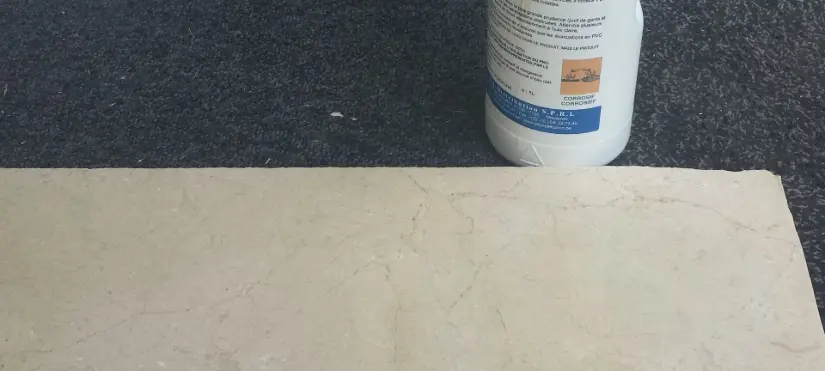
A classic test to be performed on natural stone consists of pouring a strong acid (for example toilet descaler) on the floor. If it starts to bubble, the stone is calcareous and can be crystallized.
If no bubbling appears, it will be necessary to use other techniques to achieve a gloss finish.
Test à l'acide
Hardness
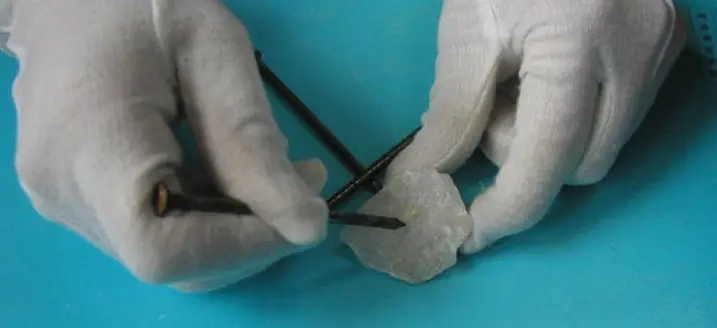
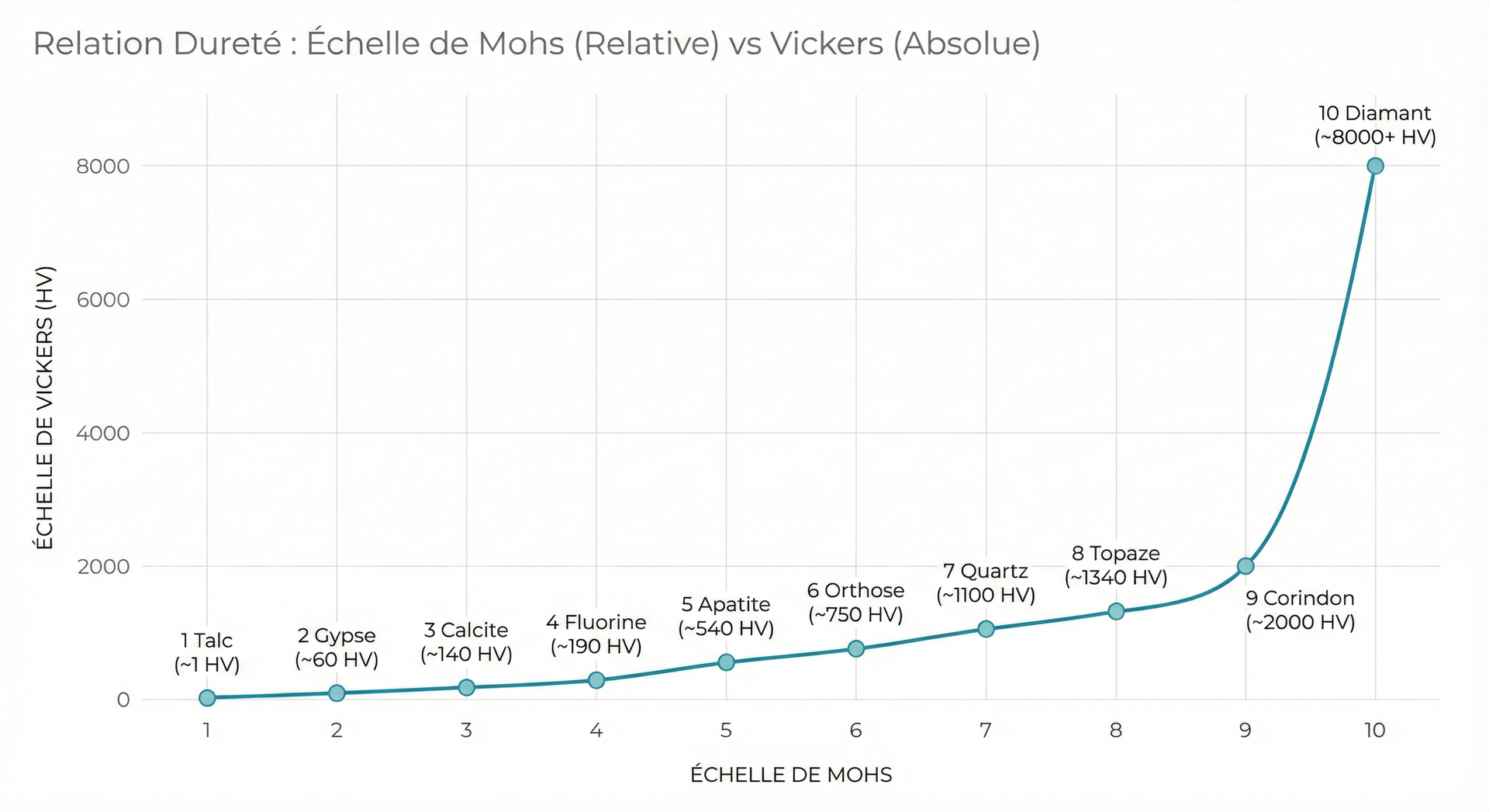
The hardness or resistance to scratching of stone is generally rated on the Mohs scale. The Mohs scale ranks stones for their ability to scratch and others. Only diamond is capable of scratching all the other materials and is rated 10 on the scale of Mohs. You can evaluate the hardness of your floor by scratching with a piece of copper (hardness < 3), a knife (hardness < 5) and a lime (hardness < 6).
The hardness of marble and granite is also often linked to its color. The hardest marbles are beige and red. The softest marbles are brown and black. The softer the floor, the more it will require regular maintenance.
The hardness of ceramic tiles and synthetic floors depend on the fabrication temperatures of the tiles and is also inversely proportional to their porosity. The harder the stone, the less porous it will be. The hardness of ceramic tiles can often be evaluated when controlling the level of porosity.
Test de dureté
Voici la traduction en anglais : > Our company specializes in consulting, product development, and customer support. We tailor our services to the specific needs of businesses across various industries to help them grow and succeed in a competitive market.
Dureté | Minéral |
1 | Talc : friable sous l'ongle |
2 | Gypse : rayable avec l'ongle |
3 | Calcite : rayable avec une pièce cuivrée |
4 | Fluorite : rayable au couteau |
5 | Apatite : rayable au couteau |
6 | Orthose : rayable à la lime / par le sable |
7 | Quartz : raye une vitre |
8 | Topaze : rayable par le carbure de tungstène |
9 | Corindon : rayable au carbure de silicium |
10 | Diamant : rayable avec un autre diamant |
Porosity level
The degree of porosity of the floor can be intrinsic ( like terracotta and some other porous natural stone) or related to its wear and poor maintenance habits ( cleaning with acid).
Porous stones are obviously much more sensitive to stains and need to be treated in the appropriate way.
In the first case (naturally porous stone), the floor should be protected with an emulsion or a water and oil repellent. These floors in general can’t be polished to obtain a natural gloss finish.
In the second case (poor maintenance), grinding of the damaged surface and polishing and crystallization allow to return to the original material and facilitate maintenance after the treatment.
It is quite easy to evaluate the level of porosity of a floor through several tests. The floor should be lightly sanded (sand paper #400) to ensure that the protection layer is removed.
- Test 1 : Pour a little bit of water on the floor. If the water penetrates, it means the floor is porous.
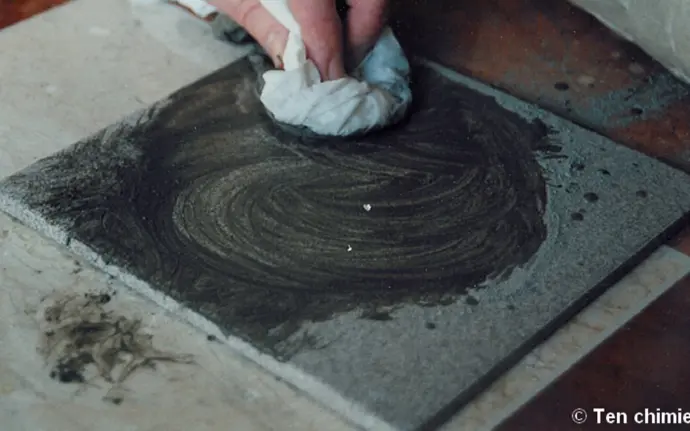
- Test 2 : Mix some dirt and dust (from a vacuum cleaner bag for example) with a bit of water and spread onto to floor. After drying, clean with a white cloth and water. When the dirt disappears completely, the floor is not porous. Otherwise it will be necessary to grind the floor and to regain the non-porous layer and to protect the floor with an emulsion.
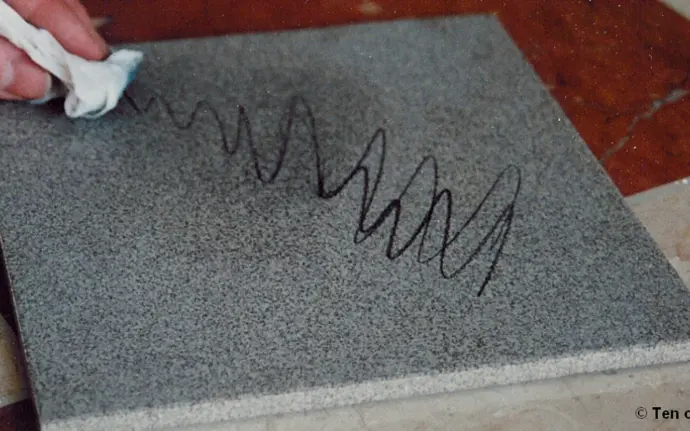
- Test 3 : Evaluate the micro-porosity (structural) with a pencil test. Draw a fine line on the tile. If the line disappears with a cloth and water, the floor is not microporous (easy maintenance). If not, it will be necessary to provide an adequate treatment.